Sunday, 20 April 2014

'Captain America: The Winter Soldier' (2014) Review

Almost a decade ago, Christopher Nolan and David S. Goyer did what many thought to be impossible. Batman, a character rooted in Gothic sensibilities, had his best film outings include a man with literal flippers and a beak who called himself the penguin and a Christopher Walken playing the bride of Frankenstein. Nolan and Goyer took those Gothic sensibilities and used them to reinvent the caped crusader and in turn revolutionized the comic book genre, sometimes for the worse. Soon after that Spider-Man donned the black suit, and superheroes stories would continue to explore the darker, angst ridden train that 'Batman Begins' set them on.

Of course that train did end up taking a nose dive...

And why wouldn't it? The Dark Knight was one of the first films in the superhero genre to make over a billion dollars at the box office. Aside from that it gained the sort of legitimacy most films can only dream of when it scored the academy award for Heath Ledger's Joker. Surely both financially and artistically it only made sense that if these movies were to evolve past the days of Bat nipples and Shrek hulk, a darker direction was essential. That's why Spider-Man has more gloom than ever and Superman is a stone cold space killer.

I repeat. Superman is a stone cold space killer. That's a problem.

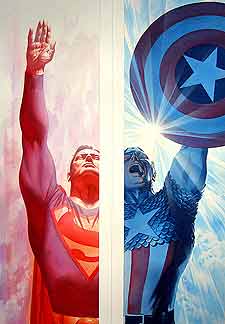
As I mentioned in my Man of Steel review, the final scenes of the film feel disconnected from the character of Superman. This isn't just the character as he exists in popular culture but in how the film itself presents him. Superman is supposed to be an ideal to strive towards, the ultimate messianic metaphor in tights, someone who upholds the values humans hold dear while maintaining the power of a god. To balance this type of boy scout character against a brooding backdrop can be trying as it either leaves the world you've established feeling unrealistic with black and white morality in which the hero doesn't have to make any hard choices, or the hero himself feels unrelatably naive. Pushing superhero movies towards a darker tone in an effort to mature the genre and the stories told within it is an admirable achievement when done right, but it can only be done right through an appreciation of the character itself. It's easy to make Batman dark because that's where he shines brightest, but characters like Superman, and Captain America for that matter, are better off standing in the sun.

Not everyone can be Batman. Not everyone should be Batman.

So with all that said, how does the latest in the genre, 'Captain America: The Winter Soldier' (CA:TWS) fare in this ongoing battle to achieve a balance of relatable realism? Well in my view, it does it better than any other before it. Picking up the pieces after the "Battle of New York" in 'The Avengers', CA:TWS, follows the star spangled man with a plan as he makes his adjustments to 21st century living. Right off the bat we're privy to this as Chris Evans' Steve Rogers makes a mockery out of Anthony Mackie's Sam Wilson in a morning jog that ends with the two sharing a meaningful conversation that will help shape their friendship throughout the film.

Anthony Mackie plays Sam Wilson, a retired Afghan vet who spends his days volunteering at a support group for veterans struggling to acclimate with their return from the horrors of war. Naturally Steve Rogers finds a friend in him as although the two have slightly different situations, Steve's war was more than half a century ago while Sam's was less than a decade, they still manage to relate to one another. After all, "War. War never changes."

Anything Perlman says is law.

After Wilson adds to Captain America's ever expanding list of things he just has to read/watch/listen that he missed with 'Trouble Man' by Marvin Gaye, an album he claims to compile everything from the last 70 years into one album, 'CA:TWS' takes the training wheels off and begins in one of the best opening sequences in a superhero film to date. Captain America, following returning femme fatale Black Widow, is now a full fledged agent of S.H.I.E.L.D, as part of his attempt to embrace the familiarity of following orders and serving his country. Steve inevitably comes to the realization that the ruthlessness and disregard for the privacy of everyday people in an effort to ensure freedom, doesn't really work for the man who just doesn't like bullies, no matter where they come from.

It's here where the movie really hits it's stride and solves the problem I spoke about before. 'CA:TWS' takes the goodness in it's main character and makes it into a redeeming quality rather than a hindrance. In a world where it's impossible to find anyone to trust, Captain America's absolute honesty is a rare and appreciated characteristic. It not only establishes him as a hero, but as a shining beacon for the films darker characters.

This should be a ridiculous character, but somehow it's not

This is where the rest of the cast falls in. Anthony Mackie's character more or less serves as an echo for Cap's good old boy sensibilities, which isn't inherently a bad thing. He provides a valuable support system for Steve in this trying time in his life. The contrast comes from Johansson's Black Widow and Sam Jackson's Nick Fury. As Nick Fury says in the film, Black Widow is comfortable with everything. She and Fury represent a by-product of the world they live in, placing their trust in few. They base their actions on the idea that they take the world as it is and not as they would like it to be. Captain America struggles with this as a man who comes from a time when things weren't so veiled in shades of grey. As the movie is completely in favour of Captain America's straight edge way of thinking, it also shows the merit in a liar's mentality. Providing pitfalls in both Cap and Black Widow's ways of doing things paves the way for the characters to develop over the course of the film. Remarkably so, considering the film takes place in about the span of a week.

When the movie isn't pitting the ways of the past and the present against each other, it's making sweet love to your eyes with a barrage of fantastically choreographed fight scenes. Many people wonder how Captain America can fare against more fantastically inclined supers like Thor and Iron Man, but Captain America holds his own in this movie. The fights are closely shot but it's finally done in a way that convey's chaos instead of confusing it's viewer, which is a rarity in action movies nowadays in an attempt to procure a PG-13 rating. The punches are not pulled and it perfectly conveys the confidence that Captain America oozes as the greatest soldier in history. Close combat fight scenes provide a good amount of tension, but the film also brings that with a few tense chase scenes, either involving Nick Fury's smart car or on the rooftops of Washington. As the action scenes are as tense as the tone of the film is dramatic, there is a good balance of comedy within the film so that you get a chance to breath. Whereas Thor: The Dark World suffered from an inability to hold back the funny, 'CA:TWS' understands the value in pacing. The dread felt in one moment is not cheapened by the levity of the next.

Ah Whedon.

Speaking of tension and dread, the main villain in the movie is a force of horrifying nature. As Steve delves deeper into the secrets that shackle the world he lives in he encounters the second titular character the Winter Soldier. Completely clad in his own personal arsenal of what I can only assume is an endless supply of knives, grenades and handguns, the Winter Soldier is a slow walking silent death. From the characters first scene in which he enacts his cruelty with surgical precision, the masked menace with a metal arm chews a stick of mint gum, grabs your spine and blows a gentle chill down it. More often than not, with a character like this, his formidable nature is merely told to the audience but he never actually does anything. Such is not the case with the Winter Soldier. The character does more than enough to convince you that he is to be feared, leaving you just enough to leave to your paranoid imagination.

Chris Evans once again takes a character who, if not done right, could be cornier than Orville Redenbacher's namesake. Instead he's played in a way that throws away all your cynicism and makes you believe in his good. Johansson has played Natasha Romanoff 3 times now and has only gotten better as time went on. She crafts a widow who is undoubtedly capable with a style that doesn't seem attempted but just happens naturally. Sam Jackson is as Sam Jackson as ever but somehow that isn't a bad thing. Anthony Mackie serves his role as an understanding and charismatic sidekick and makes the most out of what he's given which while great, simply isn't much. Robert Redford, the most surprising casting choice is genuinely an intimidating force as Secretary Alexander Pierce. Most times I've found with superhero movies, there always seems to be at least one actor who doesn't seem fully committed to the role due to the genre of movie it's in and then the film suffers because whenever that actor is on screen the immersion factor is gone. This has gotten better in recent years but still, every now and then you get someone who does the movie just so their kids can see it but doesn't really do much acting wise.

Bleh.

To close out I'll say 'CA:TWS' is an excellently crafted movie with a strong understanding of it's main character, what he represents and how to translate that in a way that is relevant to today. The film presents it's darker tones and balances it with appropriate humour and the action is unspeakably good. If there is anything bad to be said about the film it would only be the fact that Captain America's shield is apparently capable of breaking the laws of physics in the way it bounces off of things and returns to Cap but once you just accept that then you should be just fine.


A.N.R = 9.7/10

P.S This movie is already the best superhero movie of all time, for the simple fact that it makes use of Captain America's pouches in a very crucial scene. I can't count how many characters in comics and in the films themselves are covered in pockets and pouches that are seemingly just for show. Aside from Batman and his utility belt, every other hero with a pocket covered belt can't seem to find any use for them other than to make a fashion statement. Must be a union thing.

Pouches. Usually useless.


Thursday, 16 January 2014

'Frozen' (2013) Review

Musicals are horrible. They're full of characters that break out into catchy songs that are juxtaposed with sometimes intense and complex feelings. They are either done in solitude in which ancillary characters ignore the fact that their new governess has taken to addressing them in melodic rhyme, or said characters are miraculously in sync with the main character's psychotic break and suffer from the same disposition that allows them to be perfectly choreographed and join the insanity with their own matching lyrics. Both of these can happen in the same movie and no there is never an explanation for it and you would be missing the point if you wanted one.

For years I used to loathe musicals based on that concept alone. While sitting in my misery as I mused over my musings my mind would often go off in the land of wonder that was the vault of musical songs that would slip through the cracks of my stubborn resistance to the musicàl. I would sing along to everything from 'Rent' to whatever my theatre loving sister would be blaring from her iPod and I would love every minute of it. I would of course hate myself for loving the very thing I had sworn to hate but I couldn't fight it anymore to quote 'La Cage Aux Folles', I am what I am. A dirty filthy musical lover. But why am I talking about musicals? This is a review for an animated movie. Everyone knows animated movies these days only have songs that feature on the latest 'Now That's What I Call Music' album that may or may not be featured in a sing/dance off involving all the cute characters at the end credits.


You get the gif.

Recently though Disney has been taking back the night. By taking back the night I of course mean slowly but surely transitioning back to the days of old where animated movies were recalled most by the songs that made their way into our hearts. I'm talking about Simba and his inability to anticipate hereditary monarchy. Recent gems that have returned to the musical format of animated movies from Disney are 'The Princess and the Frog', 'Tangled' and the subject of this review, 'Frozen' which is my pick for the best animated movie of 2013. Sorry 'The Croods'. Though I did have a soft spot for you.

'Frozen' kicks off with an ensemble song by ice cutters that's reminiscent of 'The Jungle Books' 'Colonel Hathi's March'. It immediately sets the tone of the film with a song about the beauty and harshness of ice. You're suddenly thrust into this world in which there is a constant battle between man and the natural world of which he does not fully understand. This brings us to our two leads. Yes, as 'Frozen' harkens back to Disney films from back in the day it also hides its own little innovation by following two protagonists. The story could very well be said to be about either one of said protagonists at any given point in the movie. The protagonists of which I speak are Anna and Elsa. Sisters and Princesses of the land of Arendelle. The Kingdom serves as an appropriate royal backdrop for the film, submitting Anna and Elsa into the pantheon of Disney Princesses.


"Pencil in two more white chicks!" - Disney Exec.

The meat of the film however comes from the relationship between these two royals. The sisters are introduced as kids, about 5 or 6, and immediately their bond is distinct. Anna attempts to wake her sister at the break of dawn and Elsa simply smiles and tells her to go back to sleep. At this point Anna speaks the words she knows her sister just can't say no to and voila fun ensues. It's very effective and it sells you what would become the crux of the whole film. It also reveals the more fantastic element of the film as the two girls enjoy their snow day indoors with the help of Elsa's Iceman like abilities. Of course, as good as things are, only bad can follow, and follow it does. Elsa accidentally blasts her sister with her ice powers and is suddenly forced to hide her accursed gifts forever.

The film has somewhat of a long set up and it takes about a half an hour for the main adventure to get going, but it's all worth it once it does. I was invested in the quandary of both Anna and Elsa which is complicated when they seem to be so greatly opposed. It's an interesting twist on the Disney paradigm in that, there's no moustache twirling villain in the movie. Where the drama lies is within the two sisters. Anna wants the sister she remembers from so long ago. Elsa wants to protect the people she loves. Usually this kind of familial conflict would remain a subplot to some overwrought romance angle but in this movie it takes centre stage. It's reminiscent of the previously mentioned 'Tangled' and even 'Brave' where the focus is on the relationship of a mother and her daughter. It's keeps the story feeling fresh even if it does have a few predictable beats to it.

This isn't to say that a romance angle doesn't exist in this film, but even that is played interestingly. The two love interests for Anna in this film are Kristoff, the deranged ice cutter who speaks to his reindeer Sven, and Hans of the Southern Isles, thirteenth in line for the throne. Kristoff is a relatable everyman, a bit of a loner and he helps Anna on her quest to return her sister to Arendelle after she goes into hiding in the mountains. Predictably the two bud a slight romance along the way but it feels genuine due to the fact that it began in friendship. It's a change to the eye roll inducing way Disney characters used to fall in love after one night at the ball or after being saved by a pack of wild baboons

.
But who could deny the man dressed solely in loincloth and smelled of ape excrement.

Hans is less relatable due to his status as a prince, but he is nonetheless written in a manner that makes him feel down to earth. I suppose that contrast makes him even more attractive but the relationship he has with Anna is not quite so credible. The moment she sees him she is overwrought with bliss and blush. When it comes time for the two of them to share a song with which they express their love to one another my eyes were like Tina Turner on the river, they were like the stone that papa was said to be, they were all of what Adele and her ex could have had in the deep. They were rolling is what I'm getting at, my eyes were rolling. But I suppose that was the point of the song. 

I called Kristoff deranged because, well, he is. I genuinely thought the character was a crazy person and this is even alluded to by another character, Olaf, in the movie. While in Tangled the characters would regularly refer to the horse as animal owners do (even I talk to my pets), Kristoff is different to say the least. See, when Kristoff speaks to Sven, he answers himself with what he believes Sven is thinking in a weird exaggerated Reindeer voice. Basically it's puppetry but it's especially creepy when Kristoff seemingly comes to a conclusion as to what course of action to take based on an argument with Sven i.e himself. Aside from the adulation the film is receiving for it's prominent female characters I think the film should be credited with opening the doors for schizophrenia in contemporary media. 

The allusion to Kristoff's insanity is made by Olaf. The happy snowman who likes warm hugs. Olaf provides the funniest parts of the film as his innocence and ignorance is a veritable comedy goldmine. Basically the conceit of the character is that he is a snowman that has been brought to life by Elsa's magic. He can talk, he can dance, he can sing. He's an inanimate object who can talk in an animated movie, nothing special on the surface. What is special about Olaf is that he is at points completely self aware spewing lines like "I don't have a skull. Or bones" and "Oh look. I've been impaled." with a hilarious deadpan delivery. Other times he's the snowman who longs for the warm days of summer. I can understand how people might find this character slightly annoying. He's very energetic and seems to constantly have something to say but Josh Gad makes the character loveable underneath the nuisance by completely absorbing himself in the character, not holding anything back.


Olaf incarnate. 

The other vocal stand out is the voice of Elsa, Idina Menzel, who is no stranger to the musical arts but hasn't lent her voice to a large scale animated feature before. It's no doubt that she has an amazing singing voice and she can act circles around Anna's Kristen Bell, but part of the beauty of animation is the credibility of the character's voice. Kristen Bell has a voice that suits the character Anna. Small, a bit naive but nonetheless excited. Idina Menzel has a voice that's too big for Elsa and t's not uncommon for a performer to change their voice to suit the role. It's the type of performance that can evoke the "WHAAAA.....yeah, I can see that" effect that happens when I tell people that Craig T. Nelson plays Mr. Incredible. First they go "WHAAAAAT?!" then after thinking about it they say "Yeah I can see that." However this larger than life vocal work is exactly what makes every song with Elsa work beautifully. The Academy Award nominated 'Let It Go' is so electric and addicting largely due to Idina Menzel's work with it. Because of her ability to work so well with the melody, Elsa's more emotional songs really hit harder than I think the writers expected them to. Even if when she's speaking she sounds about 20 years older.

Elsa's songs are the most emotional of the set but otherwise the songs themselves are uplifting and work well with the animators and their ability to create fantastic set pieces which is how it should be. Musicals are indeed larger than life. They take every day situations and turn them into something outlandish and extraordinary. The same can be said for the nature of animation. In an instant a song can move a character from a snowy wasteland to the seaside in a way that's quick and alive that can't be done on the stage and if done in a live action film feels out of place if not done with absolute digital precision. Even when it's not in song the backdrop of the movie is astoundingly beautiful. It delivers on what the song in the beginning promised by creating an environment that both relishes in the beauty of snow but also cowers at the harshness of it. I truly think Frozen is a fantastic movie that no doubt stands tall against both the musicals and the animated films that preceded it.

Arbitrary Numerical rating: 9/10


Monday, 11 November 2013

'Thor: The Dark World' (2013) Review

Let's face it, sequels by and large are a gamble. More often than not they struggle to find the balance between continuing the development of the characters from the original while constructing a story worthy of a minimum 90 minutes. Characters usually are left stagnant re-hashing the same old dance that made audiences love them the last go round (Ian Malcolm in 'The Lost World') or the story itself seems to be a beat for beat remake of the original except this time instead of a baby in the closet it's a monkey on the shower curtain.


Sequels: What not to do.

This is not to say that the sequel is a gamble to the studio, in fact nothing could be further from the truth. A sequel to an established property is almost always guaranteed to make more money than it's predecessor. The risk is considerably less when producing a sequel because, by virtue of being a profitable established property it can be assumed that the audience is not only familiar with the premise and characters of a universe but also yearns to experience more. Admittedly, the sequel doesn't have to work as hard as the original, which is tasked with the burden of familiarizing the audience. Lifting this burden however can lead to some sloppy storytelling and leaves you wishing you could get your money back

Thor: The Dark World however, miraculously avoids the sophomore slump and instead uses its second endeavour to improve upon its first. Beginning as the 2011 film did, The Dark World begins with Odin himself, played once again by Anthony M.F Hopkins, overlaying a flashback sequence with egregious exposition through long winded narration. It is through this sequence that the audience is treated to the introduction of the main villain, played by the ninth Doctor, and the central conflict of the film. I don't particularly like narration in film, in fact I find it a bit overwrought sometimes but the one genre I've found myself enjoying it in is fantasy. Narration makes it feel more of a mystical childhood story with giant hammer warriors and rainbow bridges. Having said that though, I can tell when it becomes an unnecessary and meddling trope rather than a beloved cliche. Frankly though, I'm under the impression that if Anthony M.F Hopkins wants to narrate, you best believe there'll be some M.F narration.


"Zeus ain't got s**t on me." - Odin

It's hard to argue its necessity however, when the same character who narrates retells the same information to another character in the film, forcing the audience to hear the same thing twice. It's double exposition which is really audience torture. It wouldn't be so terrible if the film committed this sin but once, however Odin is not so merciful. In one instance the characters exchange a few lines of dialogue about a not so sane friend of theirs who had recently become publicly unhinged. Subsequently, a news clip is shown reinforcing this plot point. Later on in the film when the character becomes increasingly relevant he is reintroduced in a scene in which characters watch the same news clip. I understand the relevance of informing both the characters within the film and the audience viewing it but there's no reason to say this cannot be done at the same time. Especially if the method of communicating this information is going to be exactly the same. The audience is forced to re learn the things they learned not half an hour ago detaching from a story that was moving at a surprisingly well balanced pace.

As jarring as these moments can be, they are admittedly few and far between. The rest of the film is well constructed and this extends to the characterization, including the titular hero. Thor has been busy since the events of the last film and remains as formidable a foe as ever with his mighty hammer 'myeh myeh'! Chris Hemsworth's performance differs from his arrogant jock of the first film as his character now calls for one that is calm, patient, with a touch of heartache, but not enough to depress the audience. He's still a being who possesses the power of the storm and a big ass hammer, with all the whimsy that goes along with that. Hemsworth's balancing act however may go unnoticed as the film is more inclined to show off his God like physique in many a gratuitous body shot for the mighty Thor. Still, I suppose if Alice Eve has to go through with it on the Enterprise then Thor shouldn't be complaining.


Decided that showing the over sexualized imagery would be hypocritical of me

Along with Thor are the mainstays from the last film. Lady Sif, the warrior's three (two really since one is off screen for most of the film drinking mead or whatever), and of course his loving family including sort of step brother and fan favourite Loki. It's with these characters that the film shines. Wheras the first film spent most of it's time on earth with a little bit of Asgard, the reverse happens here. What that gets you is the prettiest soap opera fantasy ever. I really like the way characters interact in this movie. They don't waste time telling you about their shared history but rather mention them in a natural "hey remember this" fashion. This helps the film because it makes the characters feel like they've known each other for years, which is of course how they should be. Thor and Loki bicker like the sibling rivals they are, Odin lovingly banters with his wife, and the warriors recount battles they've had in the past when celebrating the last one. It feels like real life on Asgard and the film masterfully keeps it up throughout.

Everyone does their part well and is fully committed to both the role and the premise, which further helps solidify the world. Of course, there are those who stand out as more engaging than others, namely, Anthony M.F Hopkins Odin, Idris Elba's Heimdall who is the baddest gatekeeper in all the nine realms, and of course, Tom Hiddleston's Loki. It's not surprising given the captivating performances given by Elba and M.F Hopkins in other roles and Hiddleston again owns the role as Loki. I won't touch too much on each of their performances as they all have moments that are too good to spoil, but safe to say these three made the movie for me.


Thor is giving Heimdall too many 40 degree days

Of course where there is light, there is darkness. While the Asgardian roles shine brightly the humans of midgard disappoint. Returning to the silver screen are Darcy, Erik Selvig from Avengers and the apple of the Thunder God's eye, Jane Foster. The first two characters didn't bother me but I can see people having problems with them. They provide the purely funny moments in the film and as such can come off as unnecessary comic relief. The real low point to this film however is with Jane Foster. Established as a world renowned physicist with her own theory named after her, Jane's moments in the film are reduced to her fawning over Thor's majestic curls. There are moments in which she says something scientific, like trying to provide the logical equivalent to the "magic" of Asgard, but outside of these ridiculously small moments Foster is a ditsy damsel in distress. I hate to make comparisons to the first film when discussing a sequel but when it comes to characters I believe it's justified. When Thor arrived in the original Jane was not the doe eyed mistress pining for the approval of Thor's dad and trying to impress his mom. She was a scientist obsessed with trying to make sense of a monstrous astronomical event. The film leads you to believe that in the two years Thor was absent Jane spent her days kind of continuing her research but mostly looking out the window crying into a tub of ben and jerry's and hoping Thor was watching the same stars. The ridiculous nature of the character is even more appalling when taken into consideration with Thor. Thor is shown to have little snippets of watchful wonder doting on his loved one but in the next scene he's using his hammer to knock a rock monster into pebbles. Why is it that the male counterpart of the relationship is seemingly so much better off than the female? Doesn't it stand to reason that her research would only kick into high gear after the events of the first film? It's inconsistent characterization at it's worst and it's galling enough to force me to type not one, but TWO rhetorical questions CONSECUTIVELY, and use ALL CAPS IN CERTAIN WORDS.


More like the woman of indignity.

I haven't mentioned much about the plot because it's pretty simple and doesn't need much commentary. Bad guy wants to do something bad because he's bad. It's the less interesting part of the movie and definitely serves its purpose as the driving force of the film.There's a level of tension however that the film maintains throughout and avoids the trappings of most super hero films where the characters are all but guaranteed to live.  Christopher Eccleston is given a nasty role no doubt as the character does some pretty heinous things but there's really not much there for Eccleston to do as an actor. It's not like he has a monologue that he can sink his teeth into or anything, mostly because he speaks dark elvish for most of the film.


I know I'm supposed to scared but that sounds like a baby's gibberish.

Finally I'll talk about the look of the film. It's an absolutely gorgeous movie. The set design is an achievement and there's not an ounce of shoddy CG in the entire movie. The world of Asgard and the other realms are fully realized, and switching between them provides a nice change of environment that only helps to increase the scale of the films which helps to raise the stakes.

'Thor: The Dark World' is a mostly great film. It has its issues of course, some of them pretty glaring, but I found myself enjoying it much more than I had anticipated. I didn't feel as though I needed more than I was given and I walked out the theatre thinking, "I kinda wanna see that again". Which is definitely a good sign for any movie.

Arbritrary Numerical Rating: 8.8/10

Sunday, 10 November 2013

'Elysium' (2013) Review

One of the most important rules of story telling is "show, don't tell". Essentially, what it means is that, instead of explaining the importance of something to the viewer, the story teller needs to simply show it as it is and trust that the viewer is invested enough in the story to pick up on the pertinence of that story element. The technique can either be used to further the story or bring across a particular metaphor within the story. With film being a visual medium it is perhaps the easiest and most important medium to apply this technique, and of all the genres of film, Science Fiction is perhaps the hardest and most difficult.

A quote from Chekhov as in 'Chekhov's gun'


Science Fiction is a genre which applies this technique through allegory. Taking real world ideologies and masking them in a quasi realistic universe. It's the perfect genre to be done in as the whole basis for science fiction is taking familiar science fact and proposing it's exaggeration into science fiction. It's because of that initial familiar basis that we are able to connect to our favourite science fiction stories, and a continuation of that connection rests in the allegory proposed by the films elements.

Star Trek is an allegory for the U.N, Godzilla is an allegory for the effects of Hiroshima and Nagasaki, and more recently, District 9, directed by Neill Blomkamp, is an allegory for the Apartheid system. The key in what made those films successful is that symbolism aside, there was always an engaging plot with interesting characters. A success unfortunately not found in the latest from Mr. Blomkamp, 'Elysium'.


Matt Damon plays generic white protagonist #103,978,593,713,850,707,042

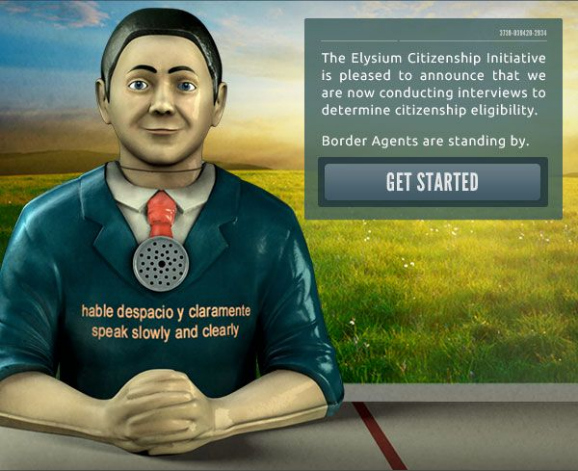
'Elysium' is set in post-apocalyptic 2154 on an overpopulated and ruined Earth, complete with copious amounts of dust, dirt and grime. The film never specifies what causes the Earth to assume this ruined state but the fault is implied to lie with man's action and inaction. In the wake of the unfavourable condition that now plagues the planet, the wealthiest of Earthlings have opted to separate themselves from the less fortunate through the development of the very first country club in space, Elysium. Complete with household medical scanners that cure cancer, lush green gardens and robot servants, Elysium trumps Earth any day of the week, and is the driving force behind the films main protagonist Max, played by Matt Damon.

Max is a down on his luck ex-con whose whole life, much like the rest of the Earth's population, has been spent trying to accumulate the funds to acquire a ticket to paradise. Throughout the first half of the film we are treated to his daily routine, working at a robot construction factory, dealing with robot parole officers and robot policemen.


The symbolism of machine run Government is also painfully obvious

As the film goes on however Max is presented with a chilling conflict for which the only solution would be to find a way to get to Elysium before it's too late.

Matt Damon plays the role well and grounds the film immensely as he is successful in presenting the relatable every man who is thrust into an impossible and fantastic situation. The same can be said for the other characters on Earth like Alice Braga's Frey who plays a nurse with a heart of gold whose only real care in the world is her daughter. The most outlandish of performances come from the characters on Elysium. Perhaps this was intentional in portraying the population as elitist as possible, but I found the characters to be over the top, and not in the good sense. In a movie in which most of the characters feel so real, a few feel like cartoon characters and make it difficult to buy the movies premise. I didn't find myself  believing that what the movie proposed would be a reality simply because the characters did not themselves feel real. In the first scenes of the film Jodie Foster's character orders a ship of illegal would be Elysium citizens to be shot down, killing everyone on board. Being the opening of the film, it feels like a hollow moment simply because the movie hasn't earned it yet. Yes Foster's character is further presented as having a controversial and violent approach to things but the character herself never earns this establishment, which can be credited to Foster's performance.


I remember when you were Travis Bickle's girl

Characterization issues aside, the movies biggest problem comes into what I was talking about earlier. The movie is blatant in it's message in being a reflection of the current status of healthcare, militarism and immigration in the United States. So much so that it ends up feeling heavy handed. I'm all for a movie being about something but that's why there's such a thing as subtext. Your thematic message should be somewhat coded to the viewer. Hidden within the movie to be found. It shouldn't be obvious or overstated but in fact it should be that the audience can take it that way if they so choose to. Wall e is a good example. That film could be said to have a green message encouraging better care of the environment and ourselves, or it could be said to be a classic love story between a recluse and a girl who's waaaaay out of his league.


Post apocalyptic imagery be damned.

Where Elysium fails is that the core story is about the character trying to battle the issues he faces due to his social status. The hidden message then becomes the story and you actually don't feel like you're enjoying any of it.

Aside from that, there are couple things that actually became endearing to me as the movie goes on. The film actually lets the viewer figure out for themselves how this world works. What people do on Earth and Elysium and establishes it's universe pretty well. The technology alone is fascinating. It was exciting to discover what this particular droid does or what that rifle's bullets look like. The look of the film is also mesmerizing. Grime never looked so good. In fact it looks like a high definition District 9. It maintains the same rustic environments and has it's own element of beauty to it. Also the film is gore-geous. I haven't seen heads explode that way since, well, District 9. Blood everywhere and the heads make a nice *pop* when they do :).

Overall, I can say that I definitely liked the film, just not as much as I wanted to. Phony and non existent characters and a lack of an endearing story made the film feel empty to me. However, fun violence, a well thought out beautiful world, and performances by Sharto Copley and Matt Damon make the film worth a watch, just with lowered expectations.

Arbitrary numerical rating: 6.5/10

Monday, 29 July 2013

'Pacific Rim' (2013) Review

Every time I decide to write a review, it's done the night of me seeing the film. This is why my posts usually go up during the weekend at around midnight. I find it best to write my thoughts about a film after the thoughts are still fresh and they can pour into the review. Otherwise they rot, become moldy and more slosh than pour into the review. But sometimes a movie can be either so good or so bad that your brain has to let it sit for a few days. I could not sit down and accurately get my opinions across on the page. I was too excited or too furious to focus my literary efforts to a clear and coherent 8 to 10 paragraphs with a fitting conclusion, although some people would say that's the case for all my reviews, consistently feeling as if they were written by a monkey.


                                                                The monkey's name is Carl. He's the next Ebert.

Of course 'Pacific Rim' would naturally be the film to cause this, and for good reason. On the one hand it seems to be the latest CG monster destructorgy from explosion veteran Michael Bay, swapping out Megatron and the gang for some Godzilla wannabees. On the other hand sitting in the directors chair is not Mr. Bay but instead Mr. Guillermo del Toro, director of thought provoking horror and fantasy pictures devoid of the doom and gloom that comes with the genre and instead swapping it out for relatability and humour. Being a fan of del Toro's previous works, I kept optimistic, until I made note that the film was unapologetic sci-fi with little to no supernatural undertones. Not exactly Guillermo's forte. I decided to instead go into the film completely blank, which is next to impossible. I would let the film be what it was without trying to fit it within a predetermined classification box.

Once I did that? The movie surprised me.

For those that don't know, the premise of 'Pacific Rim' is relatively simple. Giant monsters from another world called Kaiju come through a portal in the Pacific, hence the title, and tear the world a new one. Mass destruction is caused in all the world's major cities and the nations of the world pool their efforts towards the production of giant mechas called Jaegers in order to combat the Kaiju threat. Each Jaeger belongs to a different country and they are appropriately used in epic battles against the Kaiju whenever they see fit to launch an attack on humanity. Giant robots fight giant monsters.


A tale as old as time itself.

Honestly if that doesn't sound appealing then you might not like this movie. As ridiculous as it sounds the movie does a fantastic job at establishing it's universe, particularly the rules by which it plays relative to the real world. This is no doubt helped by the fact that the movie begins with a narration by lead character 'Raleigh Beckett' played by Sons of Anarchy star Charlie Hunnam. The narration is played over a montage of news clips of Kaiju attacks around the world, experimentation with Jaeger prototypes and other tidbits of information, cementing within the viewer that the war against the Kaiju has been waging for more than 10 years at the beginning of the film and is coming to an end. The choice to set the film so late within the war provides the audience with characters who are experienced and learned, avoiding the tired trope of characters who are thrust into a situation and eventually as the film goes on, rise to the occasion and overcome the conflict. This is where the world of Pacific Rim is established and all within the first 10 minutes of the film, in a coherent and distinct manner. It also raises the stakes of the film. As one character puts it: they are no longer an army, they are the resistance.

It's refreshing to see a film avoid such mundane cliches of fiction by opting not to tell an origin story, avoiding cliched and annoying characters bewildered by the situation and it's also refreshing to see a film take it's premise so seriously, which helps to sell it to the audience. But while 'Pacific Rim' does this masterfully it also does the opposite, laughing at itself and being riddled with cliched caricatures. Characters in the film are basically picked out of a box and thrown into the plot.


There's the egotistical jerk with daddy issues, the reluctant hero with a dark past, his rookie sidekick/love interest with supreme talent who helps him overcome his reluctance, the hard ass military superior with a heart of gold. There are more of these in the film and they're not lost on the well versed movie goer, in fact the characters outright describe the cliches they inhibit (at one point a character actually calls another an egotistical jerk with daddy issues) but what's interesting about 'Pacific Rim' is that it seems to be aware of their character's unoriginality, embraces it and then has fun with it. It doesn't pretend as if these characters are new to the viewer, but instead revels in the fact that they aren't and somehow it works. It's as if the film decides to take a look at these characters, depends on your familiarity with them, and writes them in a way that's sort of meta and tongue in cheek. Instead of rolling your eyes at Burn Gorman's over the top posh British accent, mannerisms and flamboyance, you're laughing along with it. I mean for crying out loud, the movie has characters named, 'Stacker Pentecost', 'Hannibal Chau' and 'Hercules Hansen'. Clearly these characters are not to be taken seriously.


This man speaks through that snobbish pout throughout all of his scenes and I love every second of it.


To speak of the way in which the film doesn't take itself too seriously I'll simply describe scene in the film that really makes me smile. If you'd really rather be completely surprised you can skip this paragraph and just take my word for it. After a Kaiju attacks a city the two scientists in the film go down to the area in which the Kaiju corpse can be found to conduct an experiment. After conducting the experiment the posh scientist suddenly becomes sick. They're surrounded by rubble and Kaiju guts so one assumes he would simply vomit on the ground. Instead the character manages to find a toilet that just happens to have survived the attack in pristine condition and vomit in the toilet bowl. There's no reason for it, the toilet just happens to be there, and he could have just as easily been sick anywhere else. Instead he finds a toilet and vomits into it. Maybe it's just me but I find that hilarious and think it shows that the film isn't afraid to have ludicrous moments like that, of which there are enough in the film so as not to wear out their welcome.

Now although I've mentioned that the unoriginal characters work to the films advantage, this is only for the most part. There are a three characters in particular that did not benefit from this methodology. Specifically the two scientists. Although I found Gorman's over the top performance as the uppity and posh doctor delightful and Charlie Day's squirrel like performance hasn't worn it's welcome yet (although I'm starting to feel that effect) I did not like the banter the film has between these two. The film tries to set up and antagonistic relationship between them, as they have opposing methods of combating the Kaiju threat, through making the characters argue every time they're on screen together. The contempt between these two is purely surface as although you can see what you're meant to get from watching them, it's just never funny or quick enough to have it's intended effect.

The other character I have a problem with is Ron Perlman's Hannibal Chau. The set up given to this character before he is actually shown on screen is intriguing and causes the viewer to shiver with anticipation for his reveal, but unfortunately not enough time is spent with him for that to pay off. You get a little taste of it and then he isn't seen again for the rest of the movie. I was deeply disappointed when I realized the man with golden armour plating on his shoes that sounded like a sword being unsheathed every time he took a step would no longer grace the screen and instead would leave me feeling as if something, perhaps a scene or a few lines of dialogue, was cut or simply thought inconsequential to the character along the script development.


"Ah jeez, y'know it's the darnedest thing? I completely forgot what I was doing in this movie. Welp, call me when you need me for Hellboy 3."


Outside of the characters, the plot moves itself along at an even pace, with a total of 4 or 5 complete Kaiju/Jaeger fights. Which are EXTREMELY FUN and stunning to watch. The digital effects are some of the most incredible I've ever seen and makes Transformers look like the cartoon it was based on. Fights are dynamic and fun to watch with surprises withing them. The Jaegers themselves are diverse with characteristics that match the country they were built in. (The Russian Jaeger looks like it's wearing a ushanka and the Chinese one is red with yellow dragons on it) They stand out amongst each other and you can create a semblance of a connection with them, as well as the pilots inside, much like a James Bond car or Tony Stark's suits. The Kaiju are unsurprisingly extremely well designed as is per Guillermo del Toro, with each of them taking cues from existing animals but exaggerating them in a way that looks mutated and alien. (One Kaiju has crustacean elements to it while another is more shark based.)

                                      
Just looking at pictures for this caption made me want to go see it again.

To be honest there's not a lot to say about 'Pacific Rim' in defense of it. Yes the plot is simplistic, the science behind it is dodgy and the characters are laughably played out, but amidst all it's apparent issues that would normally bug me to no end and cause me to hate it like other movies do, (I'm looking at you Independence Day, it's a crime that I am guaranteed to be reminded of your existence every July 4). In fact 'Pacific Rim' embraces its similarities with other films. There are slight nods to the films 'Aliens', 'Jurassic Park' and even 'Star Wars' and their influence is certainly felt in the overall product. For my money 'Pacific Rim' does it all really well and with just enough self awareness to not become eye roll inducing. It knows what it's trying to be and knows you know it too, once it gets past that it makes no apologies for being just that. If what it's trying to be appeals to you then you will have the time of your life like I did.

Arbitrary numerical rating: 9/10